The Ladder Inverted
The point, the frame, the Bang, and the ten forms of limit — the ladder read from the dimensionless point downward, and the Kingdom found to be the totality.
The Plate
the bare point, the frame, the ignition, and the ten descending figures — growing toward the Kingdom
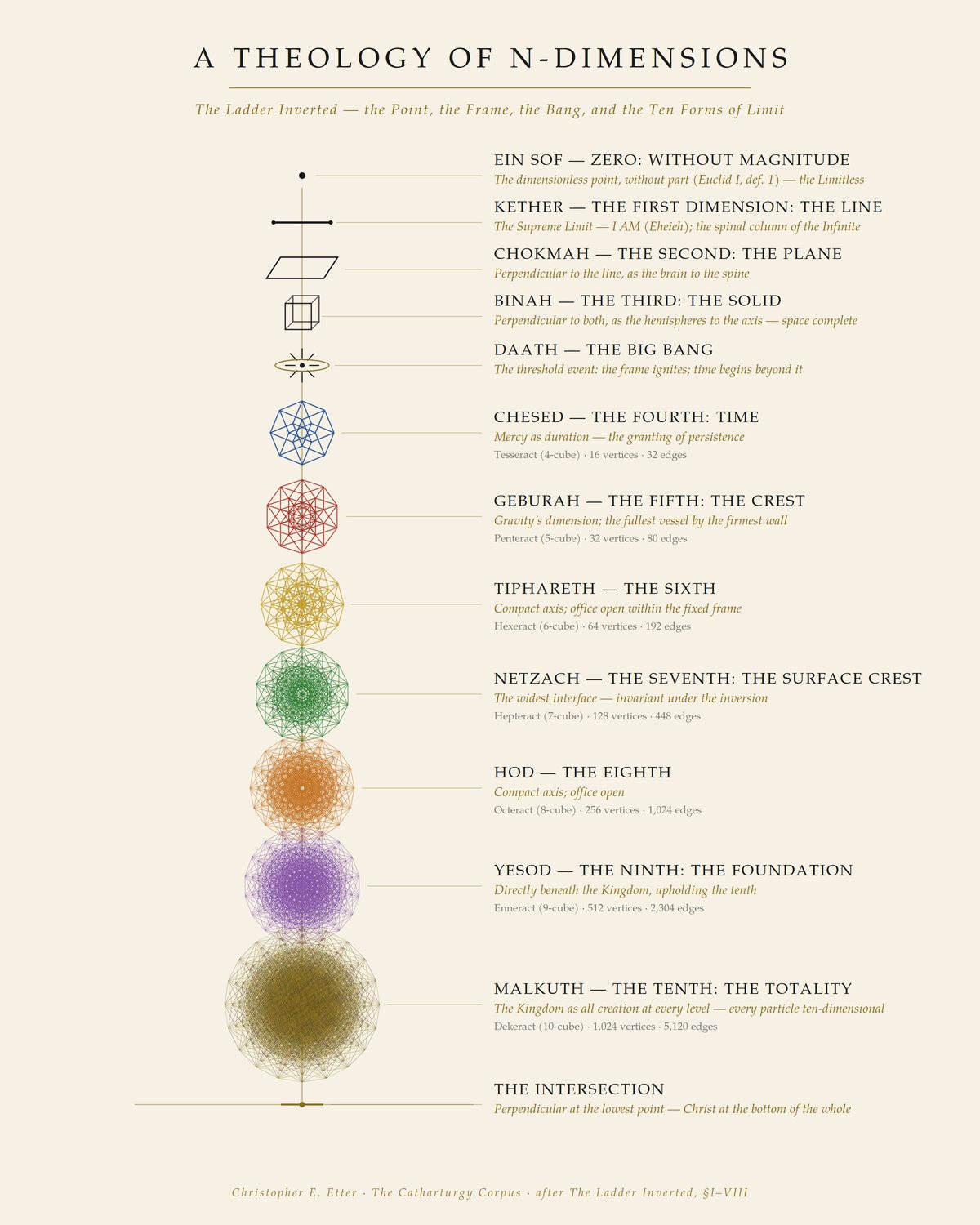
Each created dimension is drawn as its own hypercube — the tesseract at Chesed down to the dekeract at Malkuth — so that the figures grow, as the inversion teaches, the further the ladder descends.
The Point and the Frame
the supernals are not space; space is their absence, not their essence
Ein Sof is the point of Euclid’s first definition: that which has no part. It is zero — without magnitude, without boundary, claiming nothing. Its glyph is therefore the bare point, and nothing more.
Kether is the first act of limit: the form of the line, the first dimension, the Supreme Limit — I AM, personhood by first form. Chokmah is the form of the plane, set perpendicular to the line as the brain is set against the spine; Binah is the form of the solid, perpendicular to both, as the hemispheres divide across the axis. With the third, the frame of space stands complete — but the supernals are not that space. Of them the one thing that may be said with certainty is that space is their absence, not their essence: empty three-dimensional space is the Trinity’s absence in essence and its imprint in form — three because the Persons are three, one because the essence is one, empty because none of that essence is in it. The frame bears the figure of the spine-and-brain of the universe; the One whose forms it bears is present to every point of it, contained by none. Among the supernal forms there is no gradient of loss, for the descent of energy has not yet begun; the three are distinct in office and equal in being.
The Bang and the Descent
from the ignition of the frame to the Kingdom that holds all ten
Daath is the threshold event — the Big Bang — where the frame ignites. Below it the created dimensions descend and grow. Chesed is the fourth: time, Mercy as duration, the granting of persistence. Geburah is the fifth: the crest of contained measure and the home of gravity — the fullest vessel held by the firmest wall. The sixth through the ninth are compact axes with open offices; among them Netzach holds the surface crest, the widest interface any figure reaches, and it is the one ordinal that survived the whole inversion unmoved. Yesod is the ninth, the Foundation directly beneath the Kingdom.
Malkuth is the tenth and the totality. Every particle of matter is woven of all ten dimensions; the Kingdom is not the dregs of the descent but its fullest figure, the dekeract, the place where everything poured out is finally held. The divine faces count the frame exactly: three, six, and one.
The Catechism
the ladder in thirteen lines — the markers grow as the ladder descends
- Ein SofZeroThe dimensionless point, without part (Euclid I, def. 1) — the Limitless, claiming nothing.
- KetherForm of the First Dimension · The LineThe Supreme Limit — I AM (Eheieh); the form whose imprint is the spine of the frame; personhood by first form.
- ChokmahForm of the Second · The PlanePerpendicular to the line, as the brain to the spine.
- BinahForm of the Third · The SolidPerpendicular to both, as the hemispheres to the axis — the frame, their imprint, complete.
- DaathThe Big BangThe threshold event: the frame ignites; time begins beyond it.
- ChesedThe Fourth · TimeMercy as duration — the granting of persistence.
- GeburahThe Fifth · The CrestGravity’s dimension; the fullest vessel by the firmest wall.
- TipharethThe SixthA compact axis; its office open within the fixed frame.
- NetzachThe Seventh · The Surface CrestThe widest interface a figure attains — the one ordinal invariant under the inversion.
- HodThe EighthA compact axis; its office open.
- YesodThe Ninth · The FoundationDirectly beneath the Kingdom, upholding the tenth.
- MalkuthThe Tenth · The TotalityThe Kingdom as all creation at every level — every particle ten-dimensional.
- The IntersectionPerpendicular at the Lowest PointChrist at the bottom of the whole.
The Wave and the Cap
measure rises from the point, crests at the fifth, and thins into the simplicity of the heights
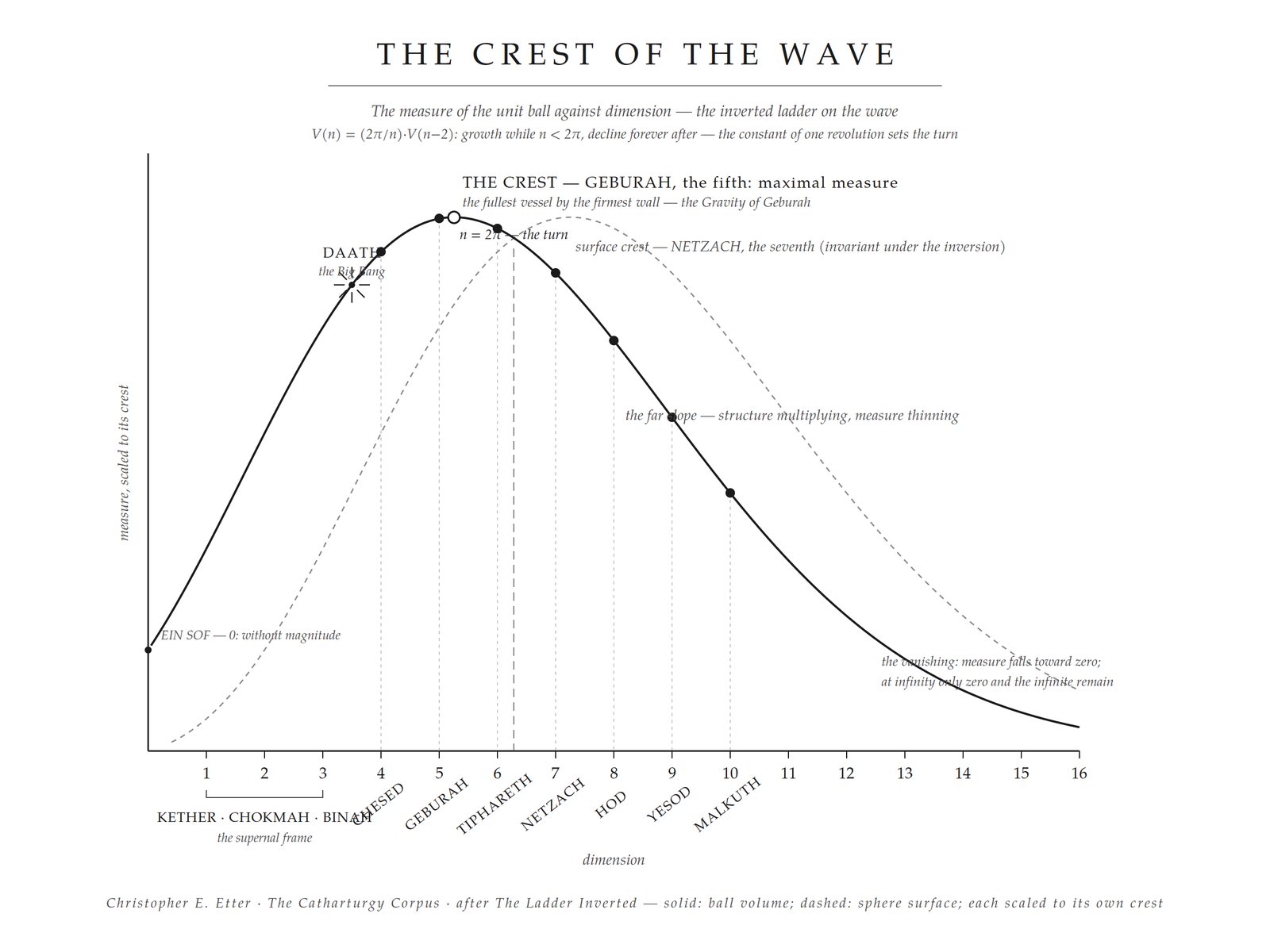
The crest of the wave — measure at its height in the fifth dimension, at Geburah.
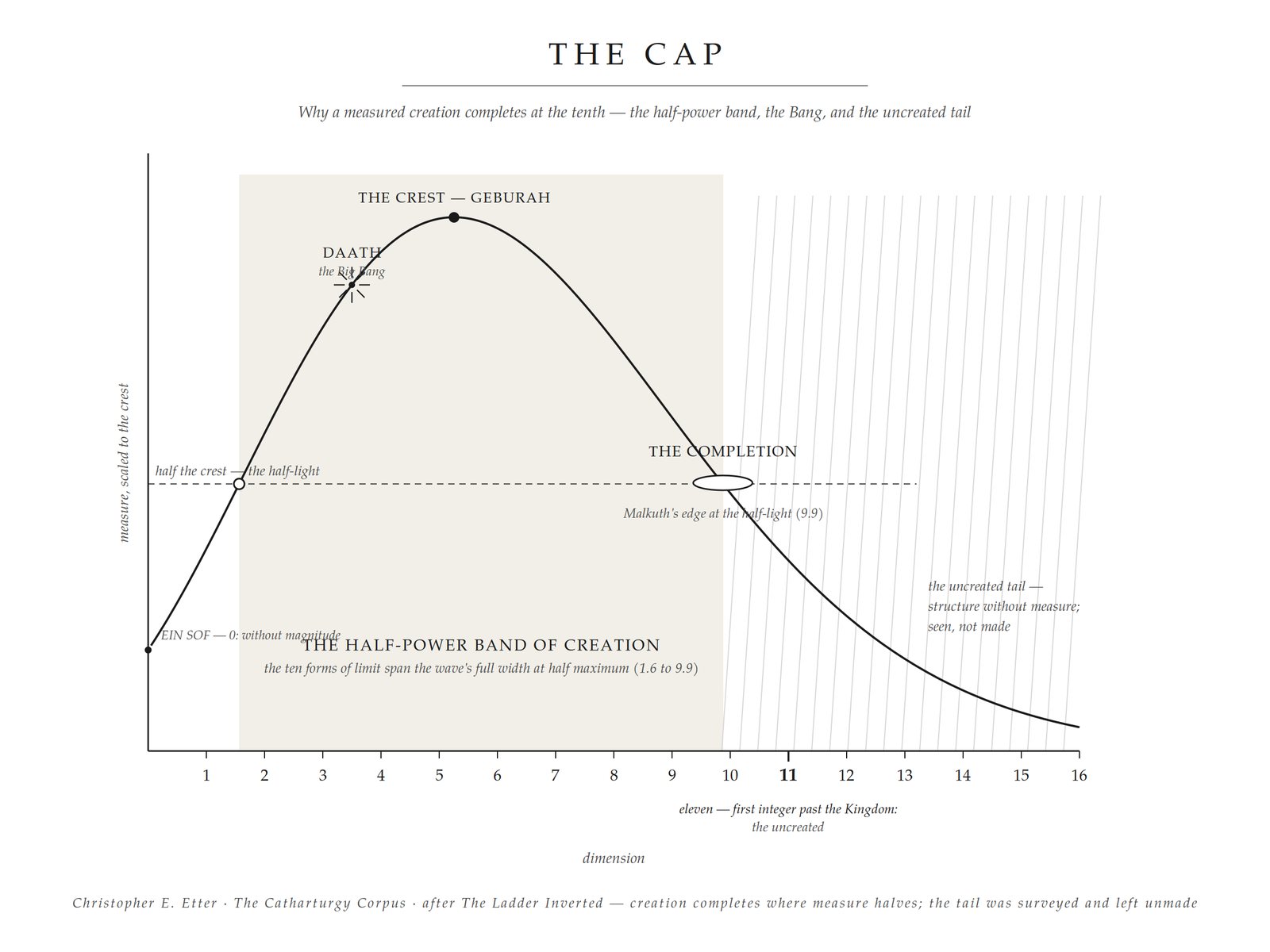
The cap — the heights growing simple as measure vanishes beyond the created ten.
The volume of the unit ball obeys one rule: every two dimensions multiply it by 2π/n. While n is small the factor exceeds one and the ball fattens; past n ≈ 6.28 it falls below one forever. The crest lands at the fifth — Geburah, the fullest vessel by the firmest wall — and the created ten live inside the wave’s bright width. The cap is not a wall but a horizon of plenitude: option-space narrowing as the forms complete.
The Honesty Ledger
The volume keeps a declared ledger of its own revisions: transfers of office made under argument, and retractions recorded rather than erased. The inversion itself was such an act — the earlier model corrected by its own rules, gravity’s office transferred from the Foundation to Severity, and the one invariant ordinal crowned for surviving the shake.
A doctrine that cannot show its corrections was never being tested. This one shows them.
The ladder was never a climb out of the world. It is the account of how the Limitless poured itself, dimension by dimension, into the world’s hands.