The Essentials of Dimensional Geometry
Six teaching plates, every figure drawn from true coordinates and every count exact — from the point to the strangeness of the heights, where the theology begins.
I · The Progression of Dimensions
each dimension is the last one moved in a direction it does not yet contain
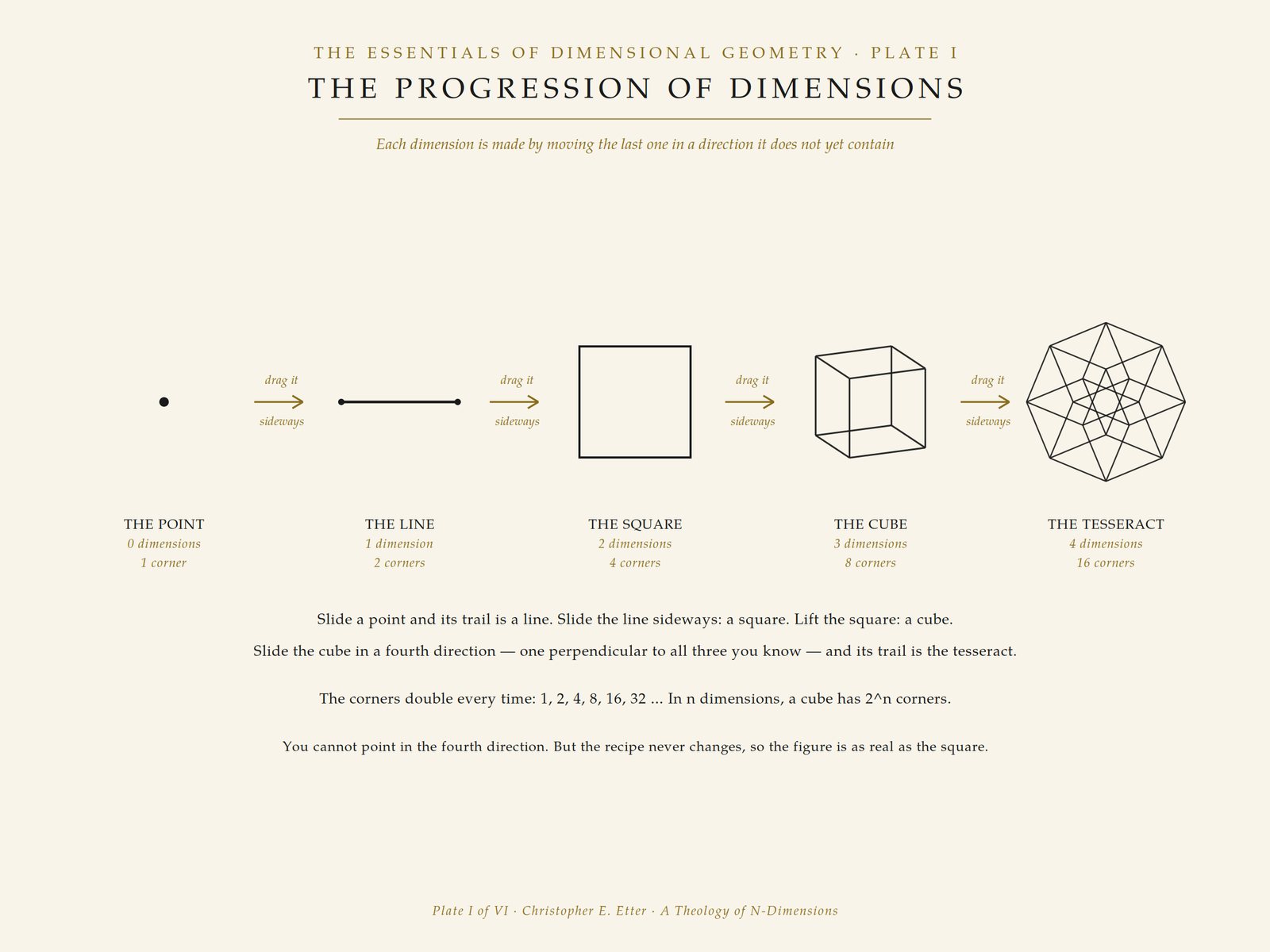
Slide a point and its trail is a line. Slide the line sideways: a square. Lift the square: a cube. Slide the cube in a fourth direction — perpendicular to all three you know — and its trail is the tesseract. The corners double every time: 1, 2, 4, 8, 16 … In n dimensions a cube has 2n corners. You cannot point in the fourth direction, but the recipe never changes, so the figure is as real as the square.
II · How to See a Higher Dimension
two honest tricks: slice it, or catch its shadow
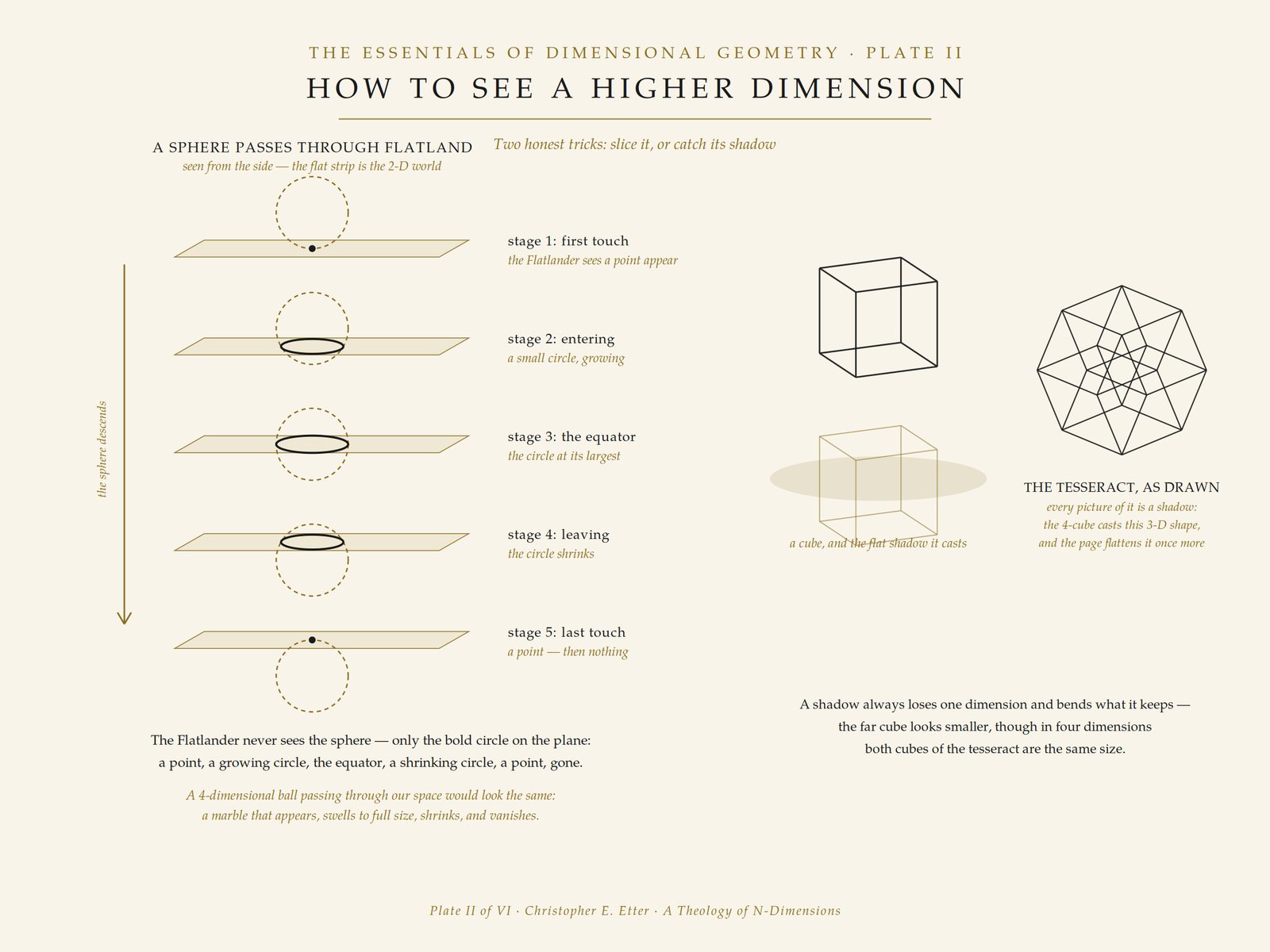
A sphere passing through Flatland appears to the Flatlander as a point, a growing circle, the equator, a shrinking circle, a point — then nothing. A four-dimensional ball passing through our space would look the same: a marble that appears, swells, shrinks, and vanishes. And every picture of a tesseract is a shadow: the 4-cube casts a 3-D shape, and the page flattens it once more. A shadow always loses one dimension and bends what it keeps.
III · The Hypercube Family
one recipe, run seven times: the n-cubes from four dimensions to ten
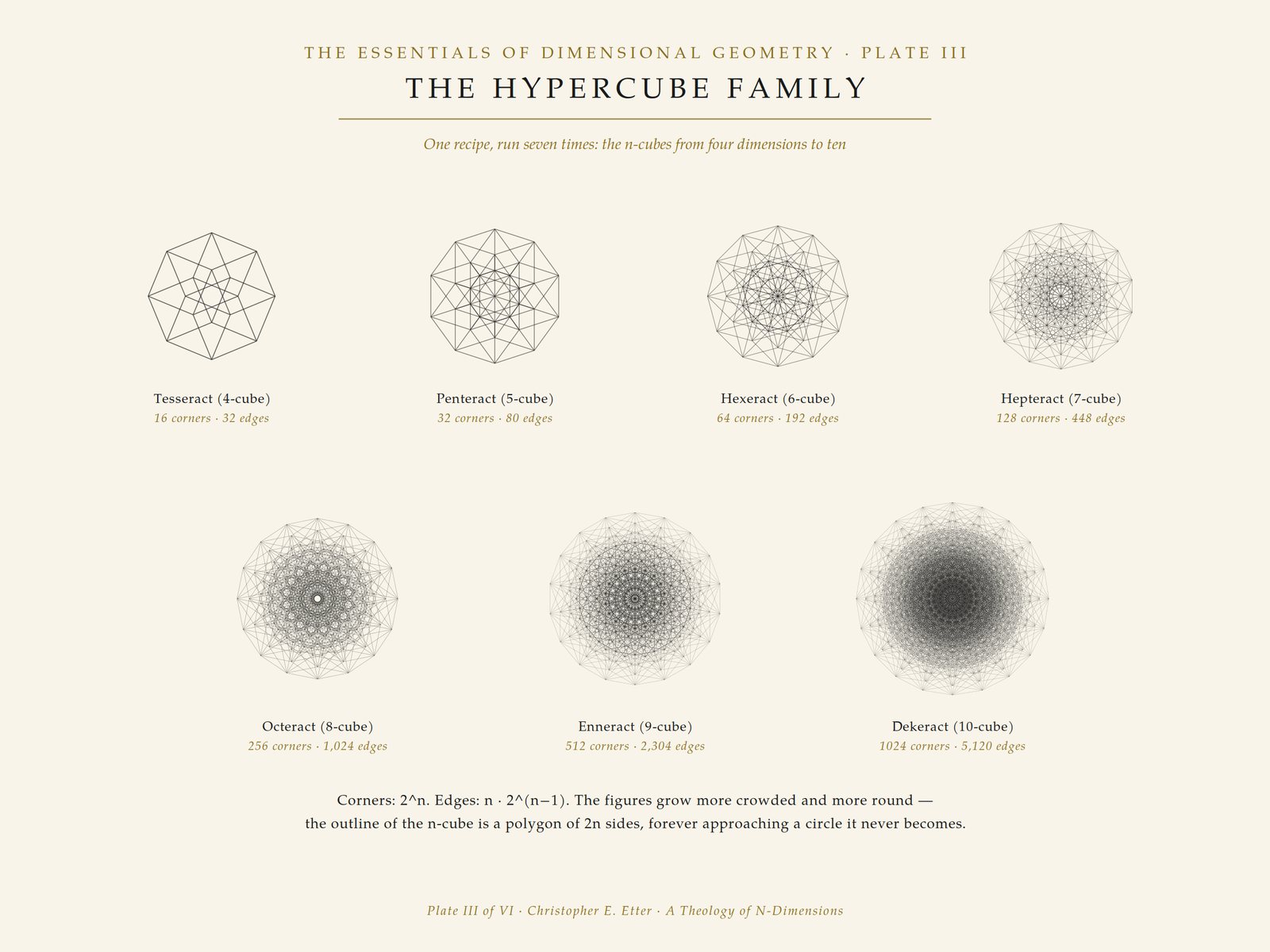
Corners 2n; edges n·2n−1 — sixteen corners at the fourth, 1,024 at the tenth. The figures grow more crowded and more round: the outline of the n-cube is a polygon of 2n sides, forever approaching a circle it never becomes.
IV · The Perfect Shapes, Dimension by Dimension
how many perfectly regular figures each dimension allows
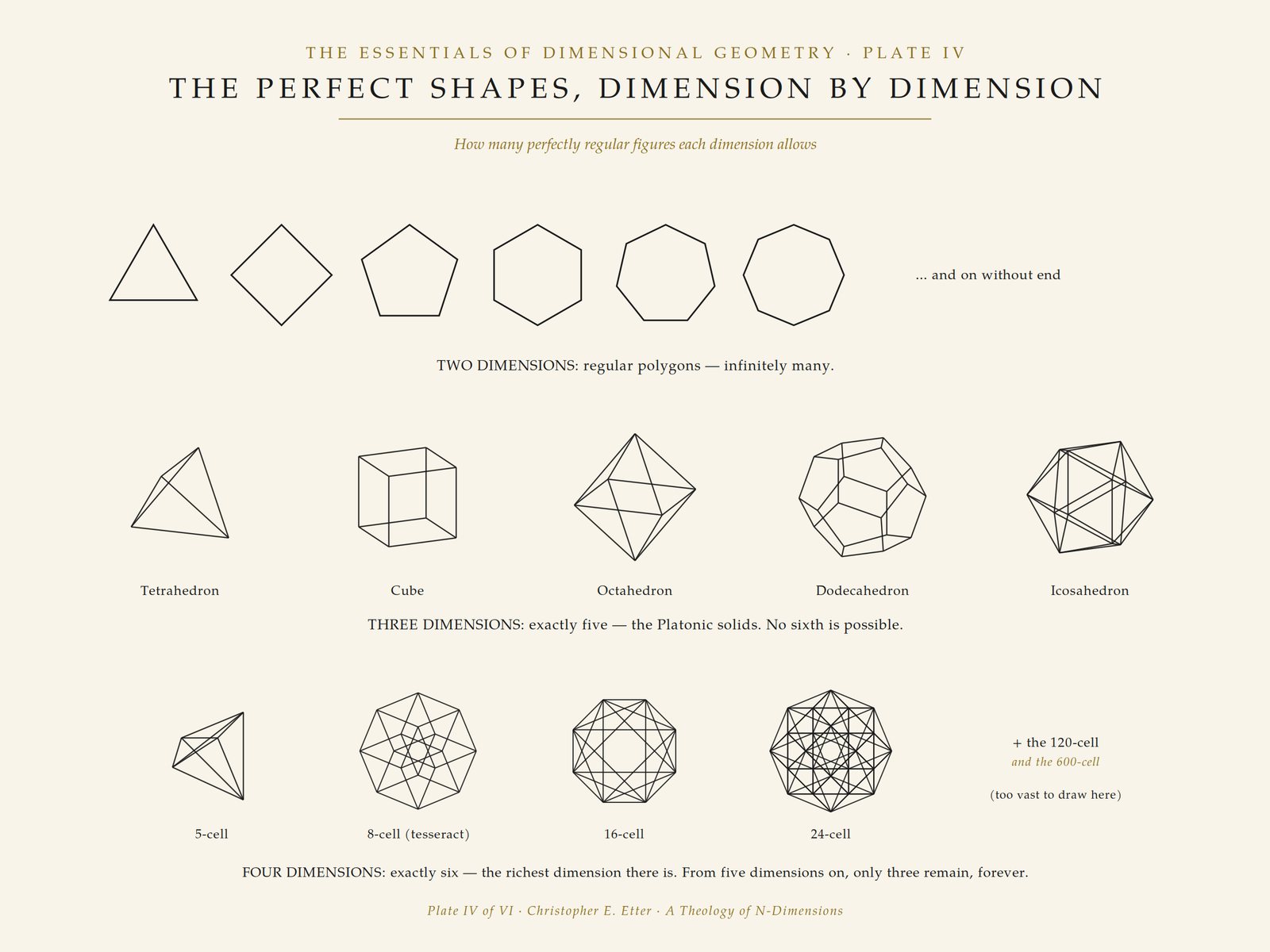
Two dimensions allow infinitely many regular polygons. Three allow exactly five — the Platonic solids — and no sixth is possible. Four allow exactly six, the richest dimension there is. From five dimensions on, only three remain, forever: the census of perfection is not a slope but a spike.
V · The Three Eternal Families
the regulars that survive in every dimension
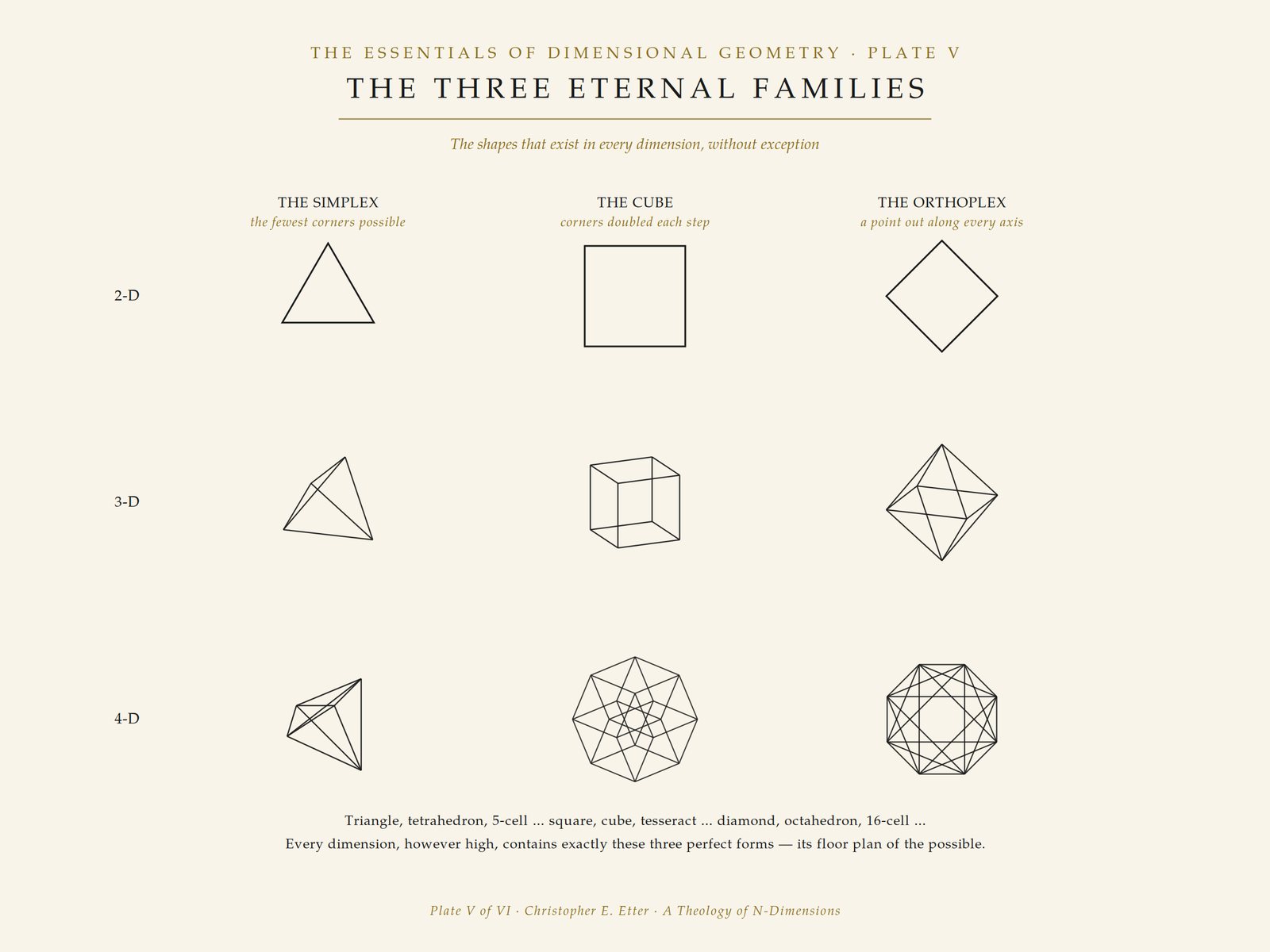
The simplex — the family of the triangle and the tetrahedron; the hypercube; and its dual, the orthoplex. Everything else perfection ever produced was a low-dimensional luxury. These three are the permanent civil service of space.
VI · The Strangeness of the Heights
high dimensions are not more of the same
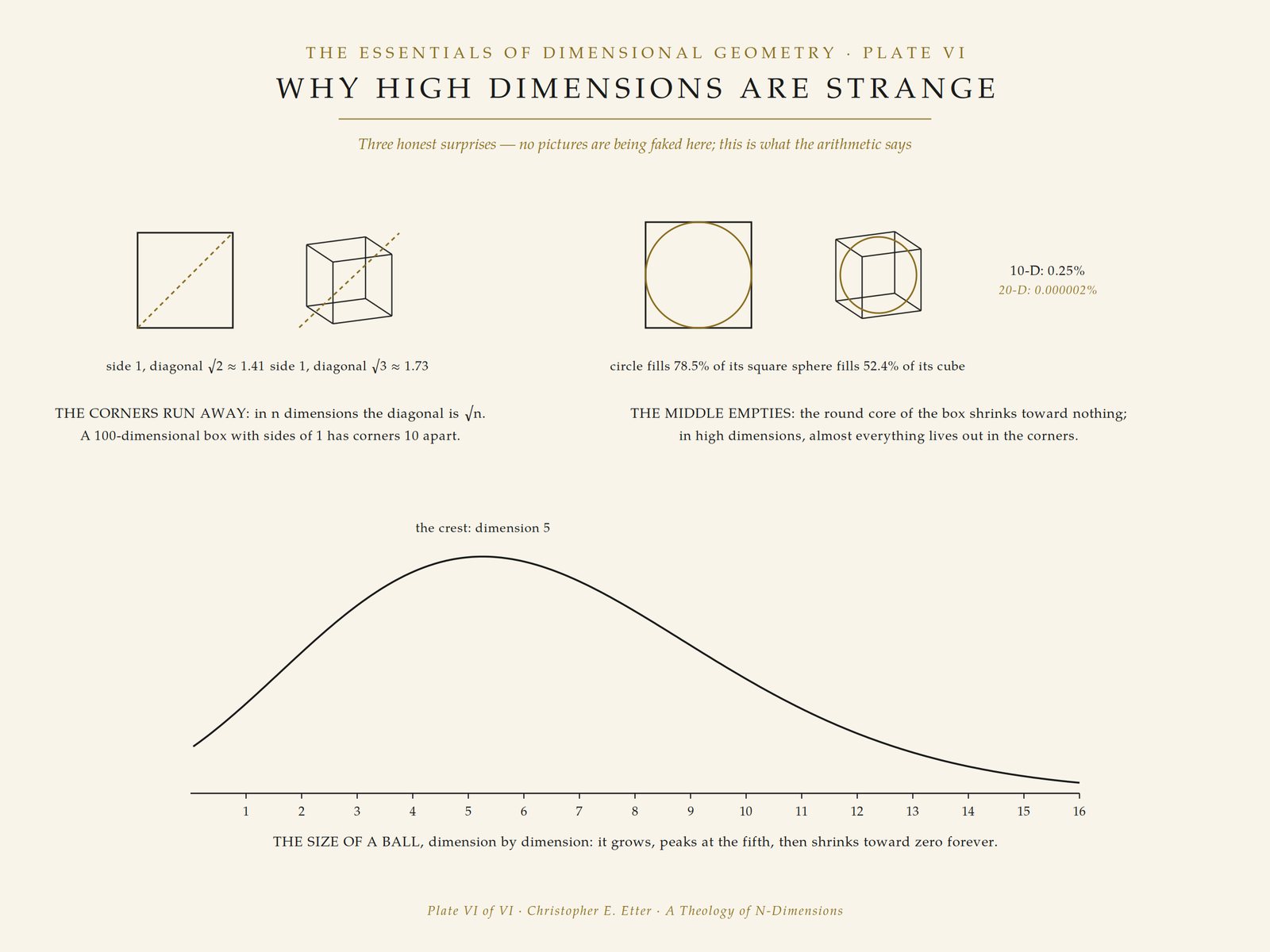
Volume flees to the corners and then to the skin; the ball of measure crests and dies; almost all of a high-dimensional orange is peel. The heights are simple and strange at once — which is exactly what the theology requires of them.
The recipe never changes; only the number of directions does. The rest of the volume asks what it means that the directions run out at ten.